A Brief Look at the Exceptional Narrative Design of 1000xRESIST
- rscpalmer02
- Jan 13
- 4 min read

“There is an us with a pattern we are threading. There is a nearness, and its gravity is echoing.” These cryptic words, along with a brief conversation and a shocking murder, set the stage for Sunset Visitor’s debut game, 1000xRESIST. The opening scene is deliberately jarring, thrusting the player into the middle of a climactic moment before transporting them backward to provide context retroactively. The game depicts an expansive story spanning over 1,000 years, exploring characters and events across generations. With impeccable writing, gorgeous visuals, and compelling themes, 1000xRESIST stands as one of the best stories the medium of video games has to offer. Given its heavy focus on narrative and thematic depth, a project like this can only come together through meticulous narrative design. Yet, through bold choices like those in the game’s opening, Sunset Visitor has managed to construct one of the standout stories of recent memory.

The story of 1000xRESIST covers a lot in its relatively short runtime: the 2019 Hong Kong protests, the arrival of aliens, a global epidemic, the end of humanity, the birth of a new world, and a number of complex characters. Such a dense narrative could have easily overwhelmed players—providing too much information without leaving enough time to develop its characters meaningfully. The writing itself is the main solution to this potential problem, with concise dialogue that subtly delivers information while simultaneously developing the roles of the active characters. On a larger level, the story finds strength in its overall structure. The game is split into ten main chapters of approximately the same length, with the exceptions of a brief prologue and epilogue. Each chapter seems to have two main goals: to explore a specific event or time and to examine a specific handful of characters, both of which contribute to a central theme.

The game’s first chapter demonstrates this structure perfectly. It explores characters to varying degrees while simultaneously outlining the events and primary conflicts of the 2047 time period. The chapter’s primary characters, Watcher, Iris, and Jiao, are explored most extensively. Watcher is portrayed as naïve, devoted to the beliefs she was raised on, but also conflicted, largely due to the influence of one of her fellow sisters. The character previously shown as the ALLMOTHER, an oligarchic figure in control of the future society, is revealed to have a previous identity as Iris, a second-generation Canadian struggling with her cultural identity. The chapter primarily focuses on Iris’s young life and her conflict with Jiao, driven by their differing experiences as members of the same diaspora culture. In the same chapter, the roles of Principal, Fixer, and The Occupant are introduced but left to be further developed later. This format, used throughout the game, allows a handful of characters to receive immediate development, sets up other characters for later exploration, and covers critical plot points, all of which link to a primary theme.

One of the greatest tools in 1000xRESIST’s narrative toolbox is the dreamlike, memory-hopping events known as “Communions.” Communions are prominent both narratively and mechanically: they exist as the unique method through which characters preserve memories and give players the opportunity to experience key events regardless of chronology. These events are especially memorable due to their surreal environments, non-linear storytelling, unique mechanics, and focused character development. Many of the early Communions feature Watcher accompanied by one of her sisters, allowing each individual and their relationship with Watcher to receive dedicated exploration, contextualized by the given event of the Communion.

These scenes are remarkably versatile; the focus on the past avoids feeling like exposition because the memories serve as a lens for the current cast to react to and therefore pushing the primary narrative forward. The unique mechanics and structures of each Communion make them even more memorable while fitting narratively, given the fragility and impermanence of the memories themselves. Many of the Communions introduce players to a new way of interacting, such as through different camera angles or control schemes. Sometimes players take the first-person perspective, experiencing a memory as a direct participant. Other times, they are restricted to a two-dimensional plane, moving back and forth as the environment changes around them. Portions like the Communions are what make 1000xRESIST so impactful. By constantly offering different perspectives and ways to interact, the game effectively creates a unique method of engaging with the piece.
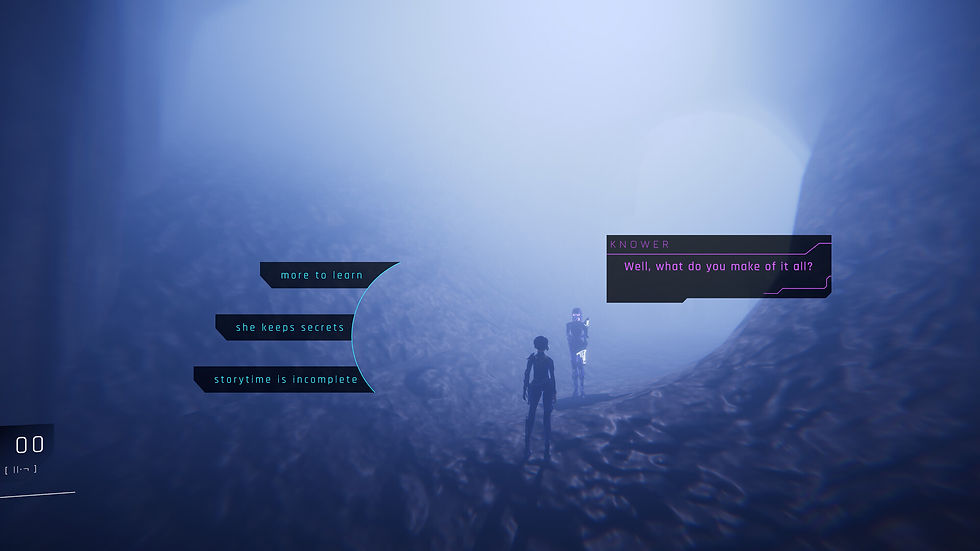
Aside from Communions and other brief sections, the main gameplay of 1000xRESIST is relatively simple, consisting of basic movement and dialogue choices. Given the large scale of some of the game’s events and themes, less pivotal conversations could have felt meaningless or unimportant. Yet, every conversation manages to maintain a certain weight, even if it does not directly contribute to the larger narrative. This effect stems from the game’s approach to interaction. By allowing players to choose certain responses, the game positions the player as a direct contributor to the conversation which increases their investment. Examining this on a larger scale reveals a recursive pattern: small choices add weight to every conversation, and when the conversations feel more important, so do the small decisions players make to guide them.

A similar effect is seen in the setting and the player’s sense of locality. By giving players the agency to navigate the Orchard freely, they begin to form emotional and mental connections to the environment itself. This is partly why, when larger changes restructure the Orchard, the effect on the player is enhanced. Not only is the space visually different but also navigationally and functionally altered. In both examples, 1000xRESIST uses the interactivity afforded by the medium to deepen immersion while maintaining the narrative integrity of a linear story.

As one of 2024’s standout hits, 1000xRESIST is a true masterclass in narrative design. Its structure, pacing, experimentation, and use of interactivity combine to create an experience that pushes the boundaries of storytelling in video games. But of course, this is only part of why the writing works so well. The content itself is equally as intriguing. The story is as experimental as it is personal, perfectly blending real-world events and deeply personal experiences with more speculative and surreal elements. The passion and talent of the team at Sunset Visitor shine through in every aspect of 1000xRESIST, making it a unique, deeply emotional experience that deserves to be experienced firsthand.


Comments